
Understanding AI as a Catalyst for Change: Spotlight on FSU’s Guang Wang, PhD
Guang Wang, PhD, an assistant professor in FSU’s Department of Computer Science, views artificial intelligence (AI) as a tool for positive social transformation. He believes AI will promote innovation in education, healthcare, and science and “empower communities and decision makers with better insights, tools, and foresight to build a more sustainable and resilient future.”
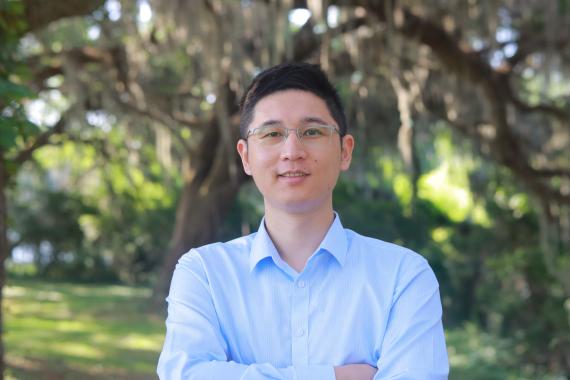
Guang Wang, PhD
Guang first encountered AI in 2014 during his master’s program in traffic information engineering and control. At the time, he was working on failure diagnosis and prognosis of railway systems, analyzing substantial amounts of data with natural language processing techniques. He became fascinated with algorithms that could quantify important words within huge sections of text. This experience sparked his curiosity in machine learning models and their ability to make data-driven predictions. He believes that AI is not only for automation but can also “assist humans in making better, faster, and more informed decisions.”
Eleven years later, AI dominates the higher education landscape and beyond. Guang’s current research focuses on spatiotemporal data mining, human-centered computing, and cyber-physical systems. “My research vision is to build a trustworthy cyber world (AI) to empower a sustainable physical world,” he says.
Guang leads the Data, Computing, and Society Lab, which is housed in the Computer Science department. The lab conducts both fundamental AI research (ie, algorithms, models, and frameworks that advance the theoretical foundations of AI) and applied AI research. He and his team use applied AI research to “translate these innovations into real-world solutions to achieve societal impacts,” focusing on domains such as mobility, energy, emergency response, and healthcare. Guang’s research “[aims] to address real-world challenges that improve quality of life, enhance business intelligence, reduce operational costs for service providers, and contribute to a more sustainable and resilient society.”
“Use-inspired AI research” especially intrigues Guang. With this type of research, “we start from real societal needs and design technologies that directly address them.” His lab works with the City of Tallahassee utilities department to “develop AI-powered models for electricity consumption forecasting and post-disaster power restoration.” This research has multiple benefits, such as optimizing the department’s operations, ensuring effective resource usage, reducing the impact of weather events, and providing a better quality of life for Tallahassee residents.
While Guang understands the concerns about the ethical implications of AI, he believes “we should embrace technological progress rather than resist it, just like we did with smartphones and the internet. ... Every major innovation in history has faced skepticism in its early stages, and AI is no different.”
We should embrace technological progress rather than resist it, just like we did with smartphones and the internet. ... Every major innovation in history has faced skepticism in its early stages, and AI is no different.